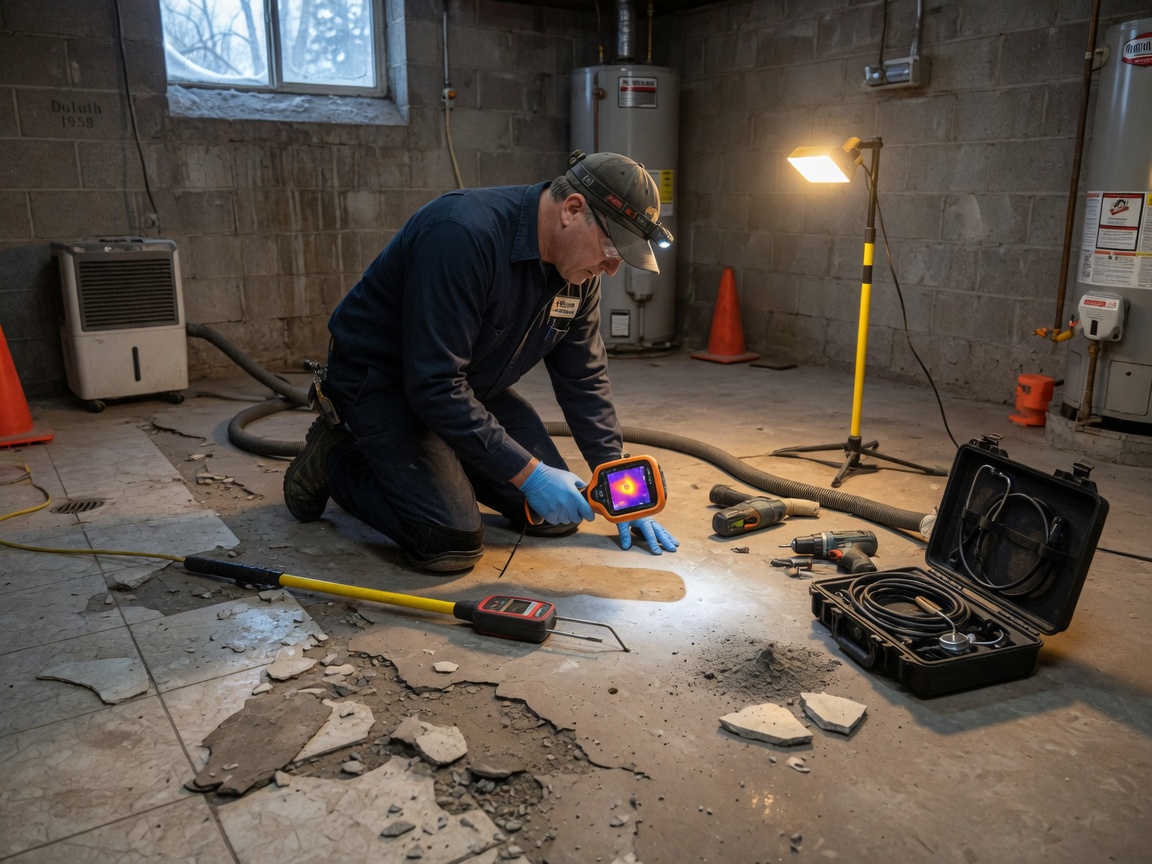
Duluth homes built on clay-heavy Gwinnett soils often experience slab movement during the humid subtropical summers when heavy rain saturates the ground followed by drier spells. This shifting stresses copper and PEX lines under the slab, creating pinhole leaks that are hard to isolate without proper equipment. Detection crews must account for the mild winters that keep soil moisture levels elevated year-round, increasing the chance of false positives from condensation around pipes near the Duluth Town Green area.
Older neighborhoods along Peachtree Industrial Boulevard frequently feature post-1980s construction with thinner slabs and fewer expansion joints, making leaks travel farther before surfacing. Technicians start with acoustic listening devices to pinpoint flow sounds through the concrete, then confirm with electronic amplifiers and moisture meters. In Berkeley Lake properties near the lake edge, higher water tables can mask leak signatures, requiring pressure isolation tests before any excavation recommendation.
Video camera inspections become essential when leaks occur near Infinite Energy Arena vicinity homes where utility corridors run close to slabs. These cameras reveal joint separations caused by repeated thermal expansion in hot summers. Crews avoid unnecessary demolition by mapping moisture gradients first, then verifying with helium or nitrogen trace gas when acoustic results stay inconclusive in noisy commercial-adjacent zones.
Technician insight
In Duluth the thing that catches most people out with Slab Leak Detection is assuming every wet spot comes from the slab when Gwinnett clay holds summer rain for weeks and wicks moisture up through expansion joints in post-1980s homes along Peachtree Industrial.
Berkeley Lake Slab Leak
Homeowner noticed rising water bill and faint floor warmth near the kitchen. Acoustic testing located flow under the living room slab while camera inspection confirmed a pinhole in the main supply line. Isolation and repair access were planned around existing landscaping without major demolition.
Slab Leak Detection Services We Offer
✓Electronic Leak Detection
Uses frequency generators and receivers to trace leaks through concrete without cutting floors in Duluth slab homes.
✓Acoustic Listening Services
Amplifies water flow sounds to locate active leaks under slabs common in Berkeley Lake and Downtown Duluth properties.
✓Video Camera Pipe Inspection
Inspects supply lines inside slabs for corrosion or joint failure in Gwinnett County homes near Peachtree Industrial.
✓Pressure Isolation Testing
Isolates sections of plumbing to confirm leak presence when soil moisture from nearby Suwanee or Lawrenceville lots interferes with other readings.
✓Thermal Imaging Scans
Detects temperature differences caused by escaping water under slabs in older Lawrenceville-adjacent neighborhoods.
Slab Leak Detection Cost in Duluth, GA
| Service | Typical Range | What Affects It |
|---|---|---|
| Basic Electronic Detection | $275–$450 | Single-story homes in Downtown Duluth; price rises with multiple zones |
| Acoustic Plus Camera Inspection | $375–$650 | Older slabs near Peachtree Industrial or Berkeley Lake |
| Full Pressure Isolation Test | $225–$400 | Required when lake-edge moisture affects readings in Suwanee area |
Ranges are typical for Duluth, GA and confirmed with an exact written quote before any work starts.
How it works
- 1
Site Assessment
Review plumbing layout and recent water bills while noting soil conditions typical around Duluth Town Green and Berkshire Hathaway HomeServices offices.
- 2
Non-Invasive Testing
Apply acoustic and electronic tools to narrow leak location without disturbing landscaping in Peachtree Industrial yards.
- 3
Confirmation Step
Run pressure or camera verification to rule out condensation from Gwinnett's humid climate before any repair plan.
- 4
Findings Report
Document exact leak point and access options for homes in Berkeley Lake or Suwanee.
Pricing
Detection pricing varies with access difficulty and number of lines tested in Gwinnett homes.